
How to Choose the Right B2B Commerce Platform
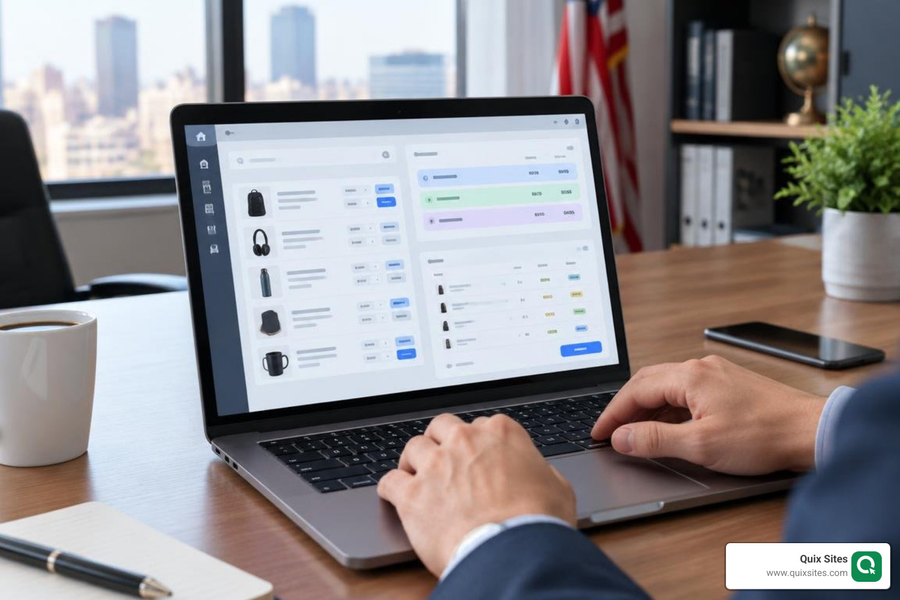
The best B2B commerce platform depends on how your buyers order and what you already use. Shopify is a practical starting point if your store is already there. An all-in-one platform may fit better when buyers need company-wide accounts, approval rules, and procurement system links. An add-on can bring wholesale ordering to an existing store without a full rebuild.
Unlike a typical retail store, a B2B site must often show each buyer the right prices, products, payment terms, and order permissions. As you compare options, test those tasks in the buyer portal and check how well orders sync with your business systems.
I'm Athena Kavis, a Shopify Partner since 2023 and a web designer who has built more than 1,000 sites. I've also founded and sold ecommerce brands, so I look at b2b commerce platforms through both the site owner's and the buyer's eyes.

Essential Features that Define Modern B2B Commerce Platforms
Business purchasing is rarely as simple as clicking "add to cart." In wholesale environments, corporate buyers don't browse like everyday shoppers—they procure. They work with strict procurement budgets, pre-negotiated tier contracts, volume-based quantity breaks, and defined corporate credit limits. Modern platforms must offer dedicated tools to support these workflows seamlessly.
To support complex business requirements, top-tier platforms provide foundational features that eliminate manual administrative bottlenecks:
- Tiered Pricing Models & Custom Catalogs: Show personalized product lines and customer-specific price sheets based on contractual agreements.
- Role-Based Buyer Permissions: Enable parent organizations to assign purchasing limits and approval authority to individual team members.
- Corporate Credit Lines & Net Terms: Offer net-30, net-60, vaulted credit cards, and automated invoicing right through the checkout interface.
- Draft Orders & Quote Requests: Allow buyers and sales reps to negotiate pricing before finalizing a digital cart into a binding purchase order.
- Bulk Inventory Uploads & Quick Reordering: Empower wholesale customers to order hundreds of SKUs using CSV spreadsheets, direct SKU entry, or saved order templates.
Implementing modern ecommerce business solutions lets brands transition wholesale operations from outdated email threads and PDF order forms into high-converting digital storefronts.
Multi-Company Hierarchies and Complex Approval Controls in B2B Commerce Platforms
Enterprise sales cycles often involve accounts with hundreds of branches, subsidiaries, and purchasing agents. If a regional procurement manager needs to place an order, company policy might dictate that any cart exceeding $10,000 requires explicit sign-off from the central finance director.

Leading platforms solve this with hierarchical account modeling. You can create parent-subsidiary account structures that share billing details while isolating local delivery addresses. Spending thresholds, department budget rules, and multi-tier approval chains run automatically, preventing unauthorized purchases and maintaining strict purchasing compliance.
AI Automation, Quoting Engines, and ERP Integration Workflows
The current era of wholesale digital transformation is heavily driven by automation. Modern Configure, Price, Quote (CPQ) tools use AI algorithms to evaluate buyer history, current inventory levels, and order volume to suggest personalized dynamic discount structures in real time.
Equally vital is how effortlessly your portal speaks to back-office enterprise systems like SAP, Microsoft Dynamics 365, Acumatica, and NetSuite. Bi-directional data synchronization ensures that inventory levels, custom ledger codes, and shipping schedules remain perfectly aligned. Furthermore, standard procurement integrations using cXML or OCI punchout protocols connect your store directly into enterprise procurement suites like SAP Ariba and Coupa. For organizations evaluating these tools, reviewing B2B portal software and integration insights provides clear guidance on structuring automated data exchanges.
Comparing the Top Enterprise Platforms for Wholesale and Direct Sales
Selecting the right software requires balancing deployment speed, integration flexibility, and total cost of ownership (TCO). Let's review how the industry's premier solutions stack up.
| Platform | Best For | Standout Features | Typical Deployment | Key Advantage |
|---|---|---|---|---|
| Shopify Plus | Fast growth & blended B2B/DTC | Native company profiles, volume pricing, headless APIs | 2–8 weeks | Up to 36% lower TCO; rapid market entry |
| Salesforce Commerce Cloud | Massive enterprise scale & CRM unification | Agentforce AI, headless architecture, 30+ native reports | 3–9 months | Leader in Forrester Wave; 99.99% uptime SLA |
| VTEX | Composable enterprise & native punchout | MACH architecture, native cXML/OCI, AI quick order | 2–6 months | 70% order processing reduction; Gartner Visionary |
| Zoey | Wholesale distributors & field sales | No-code builder, offline mobile app, AR automation | 2–6 weeks | Native CRM and offline trade-show ordering |
| SparkLayer | Existing store overlay | API-first plugin, 24-hr setup, sales agent portal | 1–3 days | Drops directly into existing storefronts |
Shopify: Fast Deployment and Scalable Wholesale Commerce
Shopify has revolutionized wholesale commerce by bringing the speed and simplicity of consumer retail into complex enterprise sales. Backed by substantial ongoing R&D investment, its native B2B capabilities allow merchants to run direct-to-consumer and wholesale operations from a single unified administrative backend.
Key capabilities include:
- Native company profiles with custom price lists and payment terms.
- Robust checkout rules supporting purchase order (PO) numbers and VAT invoicing.
- Flexible headless storefront options to create tailored buyer journeys.
Merchants adopting Shopify for wholesale frequently report up to 33% more self-serve orders within the first 12 months, alongside a 36% lower total cost of ownership compared to legacy enterprise alternatives. To understand its strategic positioning across industries, explore how Shopify compares to other e-commerce platforms.
Salesforce Commerce Cloud: AI-Driven Enterprise Scale
For multinational enterprises requiring deep integration with extensive customer databases, Salesforce Commerce Cloud stands out as a market leader. Named a Leader in the Forrester Wave for B2B Commerce Solutions, Salesforce excels at managing complex global sales operations across dozens of languages, currencies, and tax jurisdictions.
Its Agentforce AI technology delivers deep personalization, helping sales teams automatically generate optimized product catalogs and negotiate dynamic promotions. With a proven 99.99% historical uptime and more than 30 out-of-the-box analytical reporting suites, Salesforce provides the rock-solid reliability required by high-volume global corporations.
VTEX: Composable Architecture and Native Procurement Punchout
VTEX delivers a composable, API-first commerce engine built on MACH (Microservices, API-first, Cloud-native, Headless) principles. Recognized as a Visionary in the Gartner Magic Quadrant for Digital Commerce, VTEX processes over $15 billion in annual gross merchandise value across thousands of enterprise merchants worldwide.
A major differentiator for VTEX is its native procurement punchout capabilities (supporting cXML and OCI standards), allowing corporate clients to browse your digital catalog directly within their internal e-procurement software. Industry data demonstrates that VTEX implementations can drive a 70% reduction in order processing time and a 40% increase in digital channel revenue, mirroring transformations seen in the Henderson Foodservice B2B digital transformation case study.
Zoey: All-in-One Ordering for Wholesale Distributors
Zoey is purpose-built for wholesale distributors and manufacturers looking for a complete, no-code commerce platform. It bridges the gap between digital self-service buyer portals, back-office order management, and field sales enablement.
Distributors using Zoey benefit from a native mobile application that supports offline order capture and barcode scanning—a crucial tool for reps working trade shows or visiting remote warehouses. By integrating native CRM capabilities, accounts receivable automation, and direct connections to NetSuite and QuickBooks, Zoey frequently delivers a 45% post-launch sales increase while doubling operational order-handling efficiency.
SparkLayer: Modular Wholesale Layer for Existing Online Stores
SparkLayer takes an innovative modular approach: instead of requiring a complete replatform, it installs directly as an advanced wholesale layer over your current website setup. Serving over 3,500 brands, distributors, and manufacturers, SparkLayer connects your frontend directly to your backend ERP or accounting software.
Merchants utilizing SparkLayer have achieved rapid 24-hour deployments, a 75% reduction in manual admin workloads, and up to a 30% increase in average order value (AOV). For businesses looking to expand their digital channels without re-architecting their entire online presence, partnering with custom eCommerce development services can bring these modular capabilities to life smoothly.
Evaluating All-in-One Suites vs. Modular Add-On B2B Commerce Platforms

When upgrading wholesale ordering, one of the most critical strategic decisions is choosing between a monolithic all-in-one suite and a modular add-on platform.
- All-in-One Suites (e.g., Salesforce, VTEX): Provide end-to-end operational control, built-in governance, native procurement punchout, and multi-tier approval engines. However, they require higher capital investment, longer implementation timelines (often 3 to 9 months), and dedicated technical resources to maintain.
- Modular Add-Ons (e.g., SparkLayer): Allow businesses to maintain their established frontend design and checkout flows while instantly adding customer-specific pricing, quick order forms, and net terms. This dramatically reduces time-to-value and cuts initial development expenditure.
For businesses looking to launch custom digital wholesale portals, choosing the right structure is vital. Whether building lightweight B2B experiences on Wix or developing full-scale enterprise architectures on Shopify, creating tailored eCommerce websites ensures your digital sales channel aligns with your long-term growth targets.
Implementation Strategies to Maximize Wholesale ROI
Deploying wholesale ecommerce software is not just an IT project—it is an operational transformation. Research shows companies that successfully digitize their procurement achieve a 391% three-year ROI and experience a 24% boost in sales team productivity.

To capture these gains, follow proven implementation best practices:
- Map Data Schemas Early: Ensure your ERP customer IDs, custom price tier matrices, and live inventory locations map cleanly to your digital commerce endpoints before writing code.
- Empower Field Sales Teams: Provide sales reps with dedicated on-behalf-of ordering tools and mobile dashboards so they can assist clients, build custom draft quotes, and close deals faster on site.
- Incentivize Buyer Self-Service: Transition existing wholesale buyers away from phone and email ordering by offering exclusive self-service perks, such as real-time tracking, 24/7 reordering, and automated invoice downloads.
Frequently Asked Questions About B2B Commerce Platforms
What is the primary difference between B2B and B2C ecommerce platforms?
B2C commerce focuses on standard retail pricing, individual consumer checkout, and frictionless payments via credit card or digital wallets. In contrast, B2B platforms must handle complex commercial requirements, including contract-specific pricing tiers, multi-user corporate account hierarchies, credit term management (e.g., net-30 terms), draft quote approvals, and purchase order compliance.
How do B2B commerce platforms integrate with ERP and procurement systems?
Modern platforms connect to back-office Enterprise Resource Planning (ERP) tools like SAP, NetSuite, and Microsoft Dynamics using bi-directional REST and GraphQL APIs. For corporate buyers using e-procurement software (such as Coupa or SAP Ariba), platforms utilize cXML and OCI punchout protocols to let buyers browse digital catalogs directly inside their company's internal purchasing software.
What is the typical implementation timeline and ROI for enterprise B2B commerce?
Implementation timelines range from a few days for modular overlay apps like SparkLayer, 2 to 8 weeks for scalable SaaS platforms like Shopify Plus, to 3 to 9 months for complex enterprise platforms like Salesforce or VTEX. Organizations typically achieve full investment payback within 12 to 18 months, driven by up to a 70% reduction in manual order processing time and a 391% average three-year ROI.
Conclusion
The digital procurement landscape is moving rapidly toward connected, automated, and self-service buyer experiences. Whether you are scaling an established distributor, modernizing a manufacturing network, or expanding a hybrid retail brand, selecting the right software foundation ensures long-term operational efficiency and sustainable revenue growth.
At Quix Sites, we help businesses across Las Vegas, Henderson, and surrounding areas build high-performance digital sales channels that drive measurable results. If you are ready to modernize your wholesale operations and accelerate online revenue, schedule a consultation for expert ecommerce solutions with our team today.
Related guides



Want an expert to look at your website?
Share your website and we'll design a free concept for your new site, with a written quote. No cost, no obligation.
Get your free design concept