
A Logo Is One Part of Your Visual Identity

A logo is the mark people use to identify your business. A visual identity is the full set of design choices that makes your brand recognizable: your logo, colors, type, images, icons, and the rules for using them together.
For an online store, that difference matters. A great logo can catch someone’s eye, but it cannot make a product page, email, package, and social post feel like the same brand on its own. A consistent visual system helps customers recognize you wherever they find you.
A visual identity logo brings a brand’s mark, color, typography, imagery, and interface details into one recognizable system. Athena Kavis, a web designer and entrepreneur who has designed more than 1,000 websites, has seen how much stronger a brand feels when its mark and website work together.

Visual Identity vs. Logo: Core Differences and Brand Architecture
To build a brand that endures, we must treat visual cognition seriously. The human brain processes an image in as little as 13 milliseconds, and 90% of all information transmitted to the brain is visual. When a visitor lands on your website, they form an opinion in roughly 0.05 seconds. A standalone mark cannot carry that weight alone, which is why a well-built visual identity logo system matters so much to how customers perceive your brand.
A logo serves as the primary visual anchor—a signature. In contrast, your visual identity is the complete sensory environment that surrounds your audience. It includes layout grids, graphic textures, photographic treatments, motion behaviors, and typographic scales. About 75% of consumers judge a business’s credibility based on its visual design alone. If your typography clashes with your symbol, or your storefront uses discordant colors, that credibility erodes instantly.
| Dimension | Standalone Logo | Comprehensive Visual Identity System |
|---|---|---|
| Scope | Single graphic mark, wordmark, or emblem | Unified ecosystem of type, color, motion, layout, and imagery |
| Function | Immediate identification and attribution | Emotional resonance, credibility, and brand storytelling |
| Scalability | Fixed dimensions; often breaks at small sizes | Responsive multi-tier variants adapted from favicons to billboards |
| Application | Placed atop marketing assets like a stamp | Defines the structural language of every digital and physical asset |
| Business Value | Basic trademark asset | Builds long-term mental availability and brand equity |
Why a Standalone Logo Is Not a Full Visual Identity Logo System
Relying exclusively on a logo to communicate your brand values is like expecting a business card to run your sales operations. When businesses treat branding as merely ordering an isolated graphic mark rather than investing in a complete visual identity logo system, they run into practical bottlenecks immediately upon launching digital storefronts or ad campaigns.
Without broader guidelines, marketing collateral quickly becomes fragmented. One team member picks a random header font, another chooses an unapproved button color, and your social channels begin to look like an entirely different company. Exploring the branding identity of your business reveals that genuine cohesion requires deep rulesets governing spacing, hierarchy, and context. A complete system ensures your brand speaks with one visual voice across mobile viewports, social feeds, and physical packaging.
The ROI of Mental Availability and Distinctive Brand Assets (DBAs)
In modern marketing science, mental availability refers to the likelihood that a buyer will notice, recognize, and consider your brand in a buying situation. Distinctive Brand Assets (DBAs)—non-name visual elements such as specific color combinations, geometric layouts, or dynamic patterns—create structured memory links in consumer brains.
Research shows that it takes 5 to 7 impressions for a consumer to remember a brand. When your visual assets are consistent across every channel, you build those memory pathways much faster. In fact, consistent brand presentation can increase revenue by up to 23%, while companies leveraging cohesive visual systems average a 33% increase in brand revenue.
Consider how major legacy brands overhaul their presence: the Jaguar brand transformation demonstrates how high-profile redesigns are never just about changing a badge. They involve complete shifts in color philosophies, expressive modernism, and distinct visual framing. Investing in comprehensive visual branding services allows you to establish unmistakable assets that trigger recall even when your brand name isn't visible.
Core Components of an Integrated Visual Identity Logo Framework

A functional visual identity functions like an operating system for your brand. It standardizes design tokens, spatial grids, and asset treatments so every digital deployment feels intentional. Documenting these rules through meticulous brand guidelines creation ensures your team maintains total visual consistency as your business scales.
The Responsive Logo Suite: From Primary Mark to Micro-Favicon
Modern displays range from giant 4K monitors to 16-pixel smartwatch interfaces. A single detailed logo file cannot render cleanly across all of them. A responsive visual identity logo suite solves this by providing modular, vector-based variations tailored to specific screen sizes and contexts:
- Primary Brand Mark: The complete lockup featuring the primary logotype, icon, and optional descriptor, reserved for large desktop headers, signage, and presentation covers.
- Secondary Lockup: A horizontal or stacked alternative configured for tight spaces, navigation bars, and mobile banners.
- Submark / Monogram: A distilled, character-driven mark or monogram ideal for social media avatars, packaging tape, and watermarks.
- Micro-Favicon / App Icon: A simplified, high-contrast glyph stripped of fine lines, engineered for razor-sharp legibility at 16x16 or 32x32 pixels.
Global brands manage this hierarchy with absolute precision. For example, Netflix brand asset specifications dictate exact clearspace—such as maintaining margins equal to the width of a single letterform leg—and establish strict rules for when to deploy a single-letter symbol versus the full wordmark. Exploring innovative logo design frameworks ensures your marks remain distinct and legible across every digital touchpoint.
Strategic Typography Stack and Scalable Web Font Hierarchy
Typography conveys your brand's voice before a single word is read. A strong visual identity establishes a typographic stack that balances character with effortless readability across devices.
- Display / Headline Face: A typeface with strong personality used in hero sections, title banners, and marketing headers.
- Body Copy Face: A highly readable, robust web font optimized for body paragraphs, product descriptions, and long-form reading on mobile viewports.
- Functional / Monospace Face: A crisp secondary style deployed for data points, navigation menus, product SKUs, and user interface badges.
Masterful implementations, such as the custom typography frameworks crafted for major cultural institutions, demonstrate how tailored letterforms unify brands across international regions while preserving immaculate typographic balance.
Strategic Color Systems and WCAG Accessibility Compliance
Color increases brand recognition by up to 80%. When choosing a palette, we combine psychological triggers with strict digital utility:
- Dominant Hero Color: The primary shade that carries your brand's emotional weight (used across key conversion points and primary assets).
- Secondary Accent: A complementary tone used to draw attention to secondary calls to action and interactive elements.
- Neutral Foundation: A spectrum of dark tones, slate mid-tones, and off-whites that form backgrounds and body copy.
- Semantic / Action Colors: Functional shades dedicated to alerts, success states, and transactional triggers.
Modern visual systems must also comply with Web Content Accessibility Guidelines (WCAG 2.2), ensuring minimum contrast ratios (such as 4.5:1 for standard text and at least 3:1 for graphic components). Modernizing legacy systems often involves making color palettes brighter and more accessible for digital screens without sacrificing heritage recognition.
Dynamic Brand Dimensions: Kinetic Identity, Motion Signatures, and 2026 Trends

In the 2026 digital landscape, a static identity is only half an identity. Dynamic screens, interactive apps, and fluid e-commerce interfaces demand kinetic identities that move naturally. Strategic motion behaviors turn ordinary interactions into memorable brand moments.

Motion Signatures and Interactive Micro-Feedback
Motion signatures establish how your brand behaves over time. Rather than relying on gratuitous animations, thoughtful motion design provides visual feedback and smooths user journeys. Translating static emblems into fluid digital assets requires a structured creative approach.
Key elements of a motion signature include:
- Entrance & Exit Easing: How brand marks, cards, and modal windows enter the viewport (e.g., snappy mechanical springs vs. soft, elegant decelerations).
- Hover & Active States: Micro-interactions that acknowledge user intent when hovering over buttons, cards, or interactive badges.
- Loading Narratives: Branded micro-animations that keep users engaged during data fetching or checkout processing, reducing perceived wait times.
Integrating these dynamic behaviors into your branding and logo design turns passive viewing into an intuitive experience.
Navigating the AI Homogeneity Crisis in Modern Design
As generative AI design tools have become widespread, many brand aesthetics have started to look identical—dominated by generic geometric vectors, washed-out gradients, and uninspired layouts. When every startup uses the same prompts, distinctiveness disappears.
Maintaining a true competitive edge requires human-led creative strategy. While AI can assist in rapid ideation and moodboarding, the final visual system must be crafted by experienced designers who understand brand nuance, cultural context, and typographic craft. Reviewing modern brand guides highlights how clear space rules, intentional palettes, and strict usage standards protect distinctiveness. Pairing strategic insight with custom branding design services ensures your brand cuts through algorithmic noise.
Execution Pitfalls, Technical Scalability, and Legal Protections
Even striking visual concepts can fail if technical execution and legal protections are neglected. Building a scalable brand requires avoiding basic structural mistakes from day one:
- Over-Complicated Artwork: Detailed illustrations with thin lines that turn into muddy blobs at small screen sizes.
- Raster-Locked Deliverables: Using JPEG or PNG files for logos on digital platforms instead of scalable, lightweight SVGs.
- Lack of Contrast Rules: Failing to specify background rules, resulting in illegible marks on colored backgrounds.
- Inconsistent Asset Management: Distributing unorganized logo files to teams without clear usage instructions.
Setting clear parameters using a comprehensive logo and brand identity project brief prevents these execution issues before development begins.
Technical Asset Optimization for High-Performance Platforms
Web performance is a fundamental part of the modern user experience. Heavy image assets degrade Core Web Vitals, slow down page loads, and hurt search visibility.
When deploying visual systems across high-performance platforms like Wix Studio and Shopify storefronts, vector SVGs are essential. Clean SVG code renders crisply on any display resolution while keeping file sizes under a few kilobytes. Reviewing real-world logo branding projects illustrates how optimized vectors, proper font subsetting, and responsive image configurations keep storefronts fast and visually engaging.
Legal Protection and Copyrighting Your Visual Identity Logo Assets
A distinct visual identity is a core financial asset that deserves legal protection. Trademarking your primary mark, distinctive logotype, and unique brand elements prevents competitors from copying your hard-earned reputation.
To ensure your brand assets qualify for full copyright and trademark protection:
- Maintain a Human-Led Design Workflow: Current intellectual property laws require human authorship for copyright registration, making purely AI-generated graphics ineligible for direct copyright protection.
- Perform Comprehensive Clearance Searches: Verify that your proposed marks, monograms, and symbols do not infringe on existing trademarks within your industry classification.
- Document Usage Specifications: Maintain an immutable master brand kit containing vector source files, color breakdowns (HEX, RGB, CMYK, Pantone), and licensing agreements for all commercial typefaces.
Strategic Lifecycles, Rebranding Cadence, and Investment Realities
Brands are living systems that evolve alongside cultural shifts, new product lines, and changing technology. Balancing legacy brand equity with modern relevance requires a structured approach to brand updates.
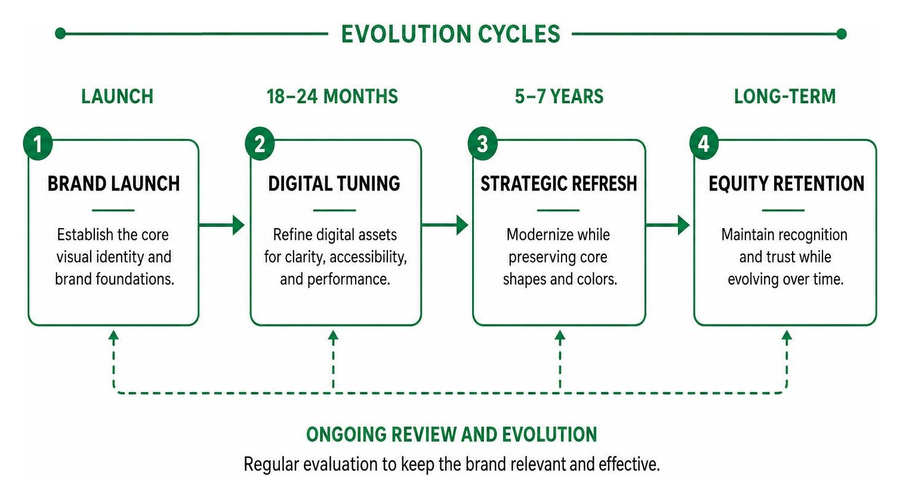
Brand Evolution Frequency: Balancing Heritage with Modernity
High-growth digital brands typically review and refine their digital assets every 18 to 24 months. These updates don't mean scrapping your logo; they involve tightening spacing, improving accessibility, and optimizing user flows.
Full-scale overhauls should generally occur only every 5 to 7 years, or during major pivots like mergers or category expansions. Changing too drastically can trigger the "Tropicana Effect"—where an abrupt redesign removes familiar distinctive assets, confusing loyal customers and hurting sales. Evolution should preserve the core shapes and colors your audience already recognizes.
Professional Investment Tiers and Measurable Commercial ROI
Treating brand identity as an investment rather than an expense delivers clear returns. McKinsey research shows that companies with top-tier design index scores outperform industry benchmarks by two to one.
| Investment Tier | Typical Scope & Deliverables | Best Suited For | Expected Business Impact |
|---|---|---|---|
| Foundational ($1,000 – $2,500) | Primary & secondary vector marks, essential color palette, typography hierarchy, basic usage guide. | Early-stage startups, local service businesses, boutique shops. | Professional market entry, immediate consumer trust, clean digital setup. |
| Comprehensive Growth ($3,000 – $7,500) | Complete responsive logo suite, full design token system, custom iconography, social assets, comprehensive brand portal. | Scaling e-commerce brands, growing B2B providers, multi-location businesses. | Increased conversion rates, unified multi-channel marketing, stronger mental availability. |
| Enterprise / Multi-Platform ($8,000+) | Bespoke typography licensing, custom kinetic motion signatures, comprehensive design system, full platform rollout. | Established enterprises, high-volume storefronts, venture-backed companies. | Market category leadership, maximized brand equity valuation, frictionless multi-team execution. |
For targeted projects, our hourly design rates start at $150 per hour, with structured custom brand packages beginning at $1,000, delivered in a streamlined turnaround time of 3 to 10 business days. Understanding the factors behind custom logo design pricing helps businesses choose the right scope for their immediate and long-term goals.
Frequently Asked Questions About Visual Identity Systems
What is the primary difference between a logo and a visual identity?
A logo is an individual graphic mark or wordmark used to identify a business. A visual identity is the complete design ecosystem that surrounds that mark, including typography hierarchies, color schemes, image styles, icon systems, layout frameworks, motion behaviors, and the usage rules that unify them across all media.
How often should a business refresh or update its visual identity system?
Most businesses should perform light visual iterations every 18 to 24 months to optimize digital performance, refine UI components, and maintain modern screen standards. Comprehensive strategic overhauls should typically occur every 5 to 7 years to protect core distinctive assets while aligning with major market shifts.
Can AI tools replace professional designers when creating a visual identity?
While generative AI tools can help with early brainstorming and moodboarding, they cannot replace the strategic problem-solving of professional designers. AI designs often lack distinctiveness, cannot account for complex web performance requirements, and carry legal risks since purely AI-generated artwork cannot be copyrighted or trademarked under current law.
Conclusion
A standalone logo is merely a starting point. To build lasting customer trust, improve mental availability, and drive sustainable growth, your business needs a cohesive visual ecosystem that performs flawlessly across every channel. From responsive vector marks and accessible color systems to fluid motion signatures, every design choice shapes how customers perceive your value.
At Quix Sites, based in Las Vegas, NV, we specialize in translating brand identities into visually stunning, high-performance digital storefronts on Wix and Shopify. Whether you're building a brand from scratch or modernizing an existing business across Henderson, Pahrump, Centennial Hills, or beyond, our team delivers personalized design systems engineered for speed and conversion.
Ready to transform your brand into a complete visual experience? Schedule a consultation for comprehensive brand identity and web design with our design team today.
Related guides



Want an expert to look at your website?
Share your website and we'll design a free concept for your new site, with a written quote. No cost, no obligation.
Get your free design concept